Everyday God Relationship

When people ask me what kind of relationship I have with God, I usually smile and say, "I have an everyday God kind of relationship."
By that, I mean God isn't someone I visit once in a while or only think about when life gets difficult. God is simply part of my everyday life—the conversations, the decisions, the joys, the frustrations, the questions, and even the ordinary moments that most people hardly notice.
I've also discovered over the years that people have all kinds of relationships with God, and each one says something about how they understand God.
Some people have what I call the "I have no relationship" relationship with God. As long as life is going well, they do their best to ignore God and run the universe by themselves. Then life falls apart, and suddenly they either sink into despair or frantically try to get in touch with God.
That reminds me of an old World War II story. A young soldier's mother, who was a devoted Christian, gave him a cross before he left for the war. She told him it would remind him that God was always with him. The soldier didn't think much about either the cross or God, but he wore it anyway because it made his mother happy.
One day, during an intense battle, he dove into a foxhole and found himself sitting next to an army chaplain. He quickly pulled the cross out from under his shirt, held it up, looked at the chaplain, and exclaimed, "Boy, am I glad to see you! Quick...tell me how this thing works!"
Many people laugh at that story, but there's a surprising amount of truth in it. Sometimes we ignore God until we're out of options.
Then there is what I call the "rich aunt or uncle" relationship—or perhaps the "Santa Claus" relationship. God is treated like a generous relative who lives somewhere far away and occasionally sends gifts. People reach out when they need something, hope God will provide it, and then go back to life as usual until the next request comes along.
Others have the "one-hour-a-week" relationship with God. They faithfully set aside an hour on Sunday—or Friday, Saturday, or whatever day they worship—and during that hour God has their full attention. But once the service is over, the relationship is put back on the shelf until next week. If bad weather, a football game, or some other activity gets in the way, well...God will just have to wait another seven days.
Then there's the "getting my ticket punched" relationship. For these folks, attending religious services is mostly about making sure they've met the requirements for eternal life. It's a little like getting a passport stamped or a ticket validated. The goal isn't to know God more deeply. It's simply to stay in compliance. As long as the ticket gets punched, everything is fine.
Of course, there are many other kinds of relationships people have with God. I could probably make quite a long list. But I think you get the idea.
The important question isn't whether we attend a church or other relious institution, pray occasionally, or believe the right things. The real question is this: What kind of relationship are we actually building with God?
Because, like every meaningful friendship, our relationship with God is shaped less by what we say we believe and more by how we choose to live each day.
So, what is a genuine everyday God relationship like?
For me, an everyday God relationship really is just that—an everyday relationship. It's an ongoing awareness of God's presence in my life. God is part of my thoughts, my conversations, my decisions, my questions, my joys, my disappointments, and even the ordinary moments that don't seem particularly important. I don't think about God only during prayer or worship. I try to live with the awareness that God is present all the time.
Unfortunately, many of us were taught a very different picture. We were taught to imagine God somewhere far away, out in the great beyond, busily managing the universe while we go about our small, ordinary lives. Every now and then, if something dramatic happens or we pray hard enough, perhaps God pauses from the really important work long enough to notice what's happening here.
It's a little like retired parents who moved from Minnesota to Florida. They still love their children very much, but they're no longer nearby. You have to call them, hope they're home, and wait for them to answer.
Many people unknowingly treat God that way—as someone who loves us but lives at a distance.
But an everyday relationship with God requires an entirely different way of thinking.
The truth is, we are not separated from God, and God is not difficult to find. In fact, I've often said that the idea of finding God is rather amusing. God has never been lost.
Neither have we.
From the very beginning, we were created for relationship—with God and with one another. Our spiritual connection with God isn't something we earn or create. It's part of who we are. We don't have to travel somewhere special or reach a certain level of spiritual achievement before God becomes available. God's presence already surrounds us and lives within us.
So why do so many of us struggle to experience that relationship?
I think one of the biggest obstacles is the belief that we're somehow unacceptable to God. We convince ourselves that we've failed too often, made too many mistakes, or simply aren't worthy of God's love. If we carry those beliefs long enough, we begin to act as though God is avoiding us when, in reality, we're the ones pulling away.
The truth is much simpler—and much more beautiful.
We are worthy of a relationship with God, not because we've earned it, but because we were created by the One who loves us. God's desire for a relationship came long before we ever thought about seeking God.
Think about it this way.
Suppose you discovered that someone you deeply admired—a person whose character, wisdom, or accomplishments you respected—thought you were an extraordinary person and genuinely wanted to spend time with you. How would that make you feel?
Most of us would be honored. We'd probably stand a little taller, smile a little more, and begin seeing ourselves differently simply because someone we admired saw something valuable in us.
Now consider something even more remarkable.
The Creator of the universe—the One who brought every star, every galaxy, every living creature, and every human life into existence—wants to have a relationship with you. Not someday. Not after you've become a better person. Not after you've finally gotten everything together.
Today.
The invitation has always been there.
Our part is not to search for an absent God but to awaken to God's presence. It's to let go of the belief that we are unloved or unworthy and begin accepting ourselves as people who are deeply loved by the One who created us.
And if accepting yourself feels difficult, remember this: if God believes you are worth loving, worth knowing, and worth walking beside every day, then there must be something wonderfully valuable about you.
Perhaps it's time to start seeing yourself the way God already does.
"Be still and know that I am God."

So, how do we begin to change the way we think about our relationship with God?
That isn't always easy, especially if we've spent years being taught that we're terrible sinners, separated from God, that God is angry with us, and that we're constantly in danger of being punished for everything we've done wrong. Whether those messages were spoken directly or simply implied, they can become deeply rooted in the way we think about ourselves and about God.
Changing that way of thinking doesn't happen overnight. It takes time, patience, and a willingness to see God—and ourselves—from a different perspective.
There are two passages of Scripture that have been especially helpful to me. One comes from the Jewish Scriptures and the other from the Christian Scriptures. Together, they point us toward a different way of experiencing God's presence.
The first comes from Psalm 46:10:
"Be still, and know that I am God."
At first glance, that sounds wonderfully simple.
In reality, it may be one of the hardest spiritual practices we will ever attempt.
Most of us aren't very good at being still. And that's not surprising when we consider how our brains are designed to work.
Think about a few amazing facts.
Our brains contain roughly one hundred billion neurons—about the same number as the estimated stars in our galaxy. Messages travel through those neurons at speeds that can exceed 260 miles per hour. Even when we're sitting quietly, our brains are consuming enough energy to power a small light bulb. Researchers also estimate that the average person experiences somewhere around seventy thousand thoughts every single day.
In other words, our minds are incredibly active. They are constantly processing, remembering, planning, analyzing, worrying, imagining, solving problems, and preparing for whatever comes next. Whether we're awake or asleep, our brains are always at work.
With that in mind, it's easy to understand why simply being still doesn't come naturally.
So why would the psalmist tell us that stillness is one of the keys to knowing God?
I don't think the writer was suggesting that we somehow stop our brains from thinking. That's impossible. Rather, I think the invitation is to stop allowing an endless stream of thoughts to control our attention for a little while.
Stillness is less about the absence of thought and more about the presence of awareness.
When we become quiet—when we stop trying to solve every problem, answer every question, or control every circumstance—we begin to notice something that has been there all along. We become aware of God's presence.
God isn't waiting for us at the end of our thinking. God is present in the middle of our lives. But our minds are often so busy that we simply don't notice.
Perhaps that's why the psalm begins with the words, "Be still." Stillness doesn't create God's presence. It helps us become aware of the presence that has always been there.
Part of our difficulty is actually a matter of language.
When the words "be still" are translated from Hebrew into English, we can easily imagine someone sitting perfectly motionless without saying a word. But the Hebrew expression carries a much richer meaning. It can be understood as release your grip, let go, relax, stop striving, or stop trying to control everything.
I find that fascinating because it changes the way I hear the psalm. God isn't simply telling us to sit quietly. The invitation is to loosen our grip on our assumptions, our fears, our need to be in control, and even the ideas we've formed about who God is and how God is supposed to work.
Being still means calming the constant chatter of our minds so that we can become aware of God's loving presence here and now. It gives us an opportunity to experience God without filtering everything through our theological assumptions, irrational fears, negative self-images, or the emotional baggage we've carried since childhood or picked up through life—and sometimes even through our religious training.
That sounds pretty simple, doesn't it?
Just be still.
Then I actually try to do it.
I sit down, ready to experience God's presence, and within seconds my mind is everywhere except where I am. I'm thinking about how long it's going to take me to finish writing this essay. Then I'm remembering how good lunch was. Before I know it, I'm planning tomorrow, replaying yesterday, solving problems that don't even exist yet, and wondering why I'm thinking about any of those things in the first place.
Does that sound familiar?
The truth is, God hasn't gone anywhere.
I'm the one who keeps wandering.
God's presence is always available, but I can only experience that presence in the present moment. My mind, however, has an amazing ability to live almost anywhere except the present. It revisits the past, worries about the future, rehearses conversations, imagines possibilities, and analyzes just about everything.
As long as I'm living in yesterday or tomorrow, it's difficult to notice what God is doing today.
That's why stillness is so important. It gently brings us back to the only place where life is actually happening—the present moment. It reminds us that we don't have to manufacture God's presence or convince God to show up. God's presence is already here.
Our task is simply to become aware of it.
Perhaps that's the greatest challenge of the spiritual life. We spend so much time trying to think our way to God that we forget to experience the relationship that is already waiting for us, right here and right now.
Why is being still so difficult?
I have a theory.
I don't think it's simply because our brains are too busy. Our minds certainly are active, but I believe something much deeper is going on. The real challenge is that genuine relationship requires us to be fully present. And for most of us, showing up fully present—especially in an intimate relationship—can feel anywhere from uncomfortable to downright frightening.
To be present with God means allowing ourselves to become emotionally and spiritually open. It means becoming vulnerable.
Most of us have spent a lifetime learning how to protect ourselves. We've built walls around old wounds, disappointments, fears, and failures. We become very good at managing the image we present to other people. Then suddenly we're invited into a relationship where nothing has to be hidden.
That can be intimidating.
Intellectually, we may believe that a relationship with God is the safest relationship we could ever have. We know God loves us unconditionally, forgives generously, and desires what is best for us. But knowing something with our minds and trusting it with our hearts are often two very different things.
Deep down, we also realize that an authentic relationship with God will be completely honest. God's love doesn't ignore the parts of our lives that need healing or growth. Instead, that love gently invites us to look at ourselves truthfully—not so we can feel guilty or ashamed, but so we can become healthier, freer, and more fully the people we were created to be.
That kind of honesty may feel uncomfortable at first, but it is never meant to condemn us. It is always intended to help us grow.
The good news is that learning to be still really is possible, and in my experience, it is one of the most rewarding practices of the spiritual life.
So how do we begin?
There isn't just one right way.
On my Spiritual Development page, I talked about my own experience studying Zen Buddhism and practicing meditation. Those practices have been very helpful for me because they taught me how to quiet my mind and become more aware of the present moment. That doesn't mean they're the best approach for everyone. Meditation can have a fairly long learning curve, and some people connect with God more easily through other practices.
One approach that many people find helpful is mindfulness. Over the past several years, mindfulness has become a widely accepted way of calming the constant activity of our minds and gently bringing our attention back to the present moment. There are many excellent books, classes, and apps that can help you learn this simple practice.
Others find that a repetitive breath prayer helps quiet their thoughts. Slowly breathing in while praying a few simple words and breathing out with another short phrase can gradually calm both the mind and the body.
Still others discover that slowly reading and reflecting on a passage of Scripture or another piece of spiritual writing allows their minds to settle and their hearts to become more receptive to God's presence.
The particular practice isn't nearly as important as the purpose behind it.
The goal isn't to master a technique. The goal is to quiet the noise within us so we can become fully present with God in the only place where life is ever lived—the present moment.
Perhaps that's why the psalmist simply says,
"Be still, and know that I am God."
The invitation isn't to accomplish something extraordinary. It's to stop striving long enough to discover that God has been present all along.
If you remember, before my rather long discussion about being still, I mentioned that there were two passages of Scripture that I believe can help us develop a healthier understanding of what it means to have an everyday relationship with God.
The first was from the Psalms:
"Be still, and know that I am God."
The second comes from the Christian Scriptures, in the Apostle Paul's letter to the Romans.
Romans 12:2
"Don't be like the people of this world, but let God change the way you think. Then you will know how to do everything that is good and pleasing to God."
I find that one sentence incredibly powerful:
"Let God change the way you think."
Notice that Paul doesn't begin by talking about changing our behavior. He begins with changing our minds.
Why?
Because the way we think shapes the way we see ourselves, the way we understand God, and ultimately the way we live. If our understanding of God is distorted, our relationship with God will be distorted as well. But if we gradually allow our thinking to be transformed by God's love and truth, everything else begins to change along with it.
That doesn't happen because God forces us to think differently. Real transformation can't be forced. Instead, it happens as we become willing to question some of the assumptions we've carried for years.
Have I been seeing God as distant when God has always been near?
Have I believed that I have to earn God's love instead of accepting that it has always been freely given?
Have I been defining myself by my failures instead of by the fact that I was created and loved by God?
Those are the kinds of questions that slowly reshape our thinking.
As our thinking changes, our experience of God changes. We become less fearful, less defensive, and more open to the reality of God's constant presence in our lives. Instead of living as though we're trying to find God, we begin living with the awareness that God has been walking with us all along.
Of course, that raises another important question.
How do we actually allow God to change the way we think?
That question deserves more than a brief answer, so I've devoted an entire section to it. On my page , Real God Relationship, I explore the negative and often destructive patterns of thinking that keep us from recognizing God's presence. More importantly, I discuss practical ways to recognize those patterns, let them go, and gradually open our minds and spirits to God's transforming love and guidance.
As you'll discover, changing the way we think isn't about learning a new set of religious ideas. It's about learning to see ourselves, others, and God more truthfully. And when that begins to happen, an everyday relationship with God becomes less of a goal we are trying to reach and more of a reality we begin to recognize.
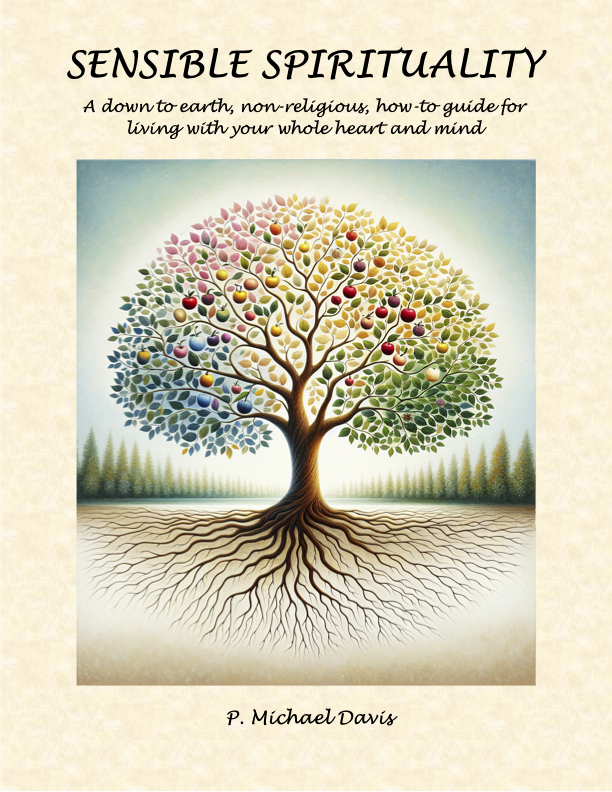
Sensible Spirituality
A down to earth, non-religious, how-to-guide for living with your whole heart and mind
While there are a multitude of books about personal development and spiritual growth, author and storyteller P. Michael Davis goes down a different path by offering a real-life conversation about how to build and maintain a positive and spiritually healthy life.
His approach is thoroughly non-religious, entertaining, and devoid of jaw clenching seriousness. He will walk you through the whys and how tos of spiritual awareness, spiritual relationship building, spiritual love, and spiritual parenting for children and adolescents.
Sensible Spirituality is available, by clicking the book cover above, in kindle, paperback, and audio book formats at Amazon.com.

Life Lessons Stories for Kids Young People and Grownups Who are Young at Heart
By P. Michael Davis
This original collection of enjoyable, entertaining, and inspirational stories communicates positive values and principles for happy and healthy living without being preachy, teachy, or boring. By bringing an assortment of unique, interesting, and appealing characters to life in these delightful tales, P. Michael Davis opens the gate into a world where things like kindness, compassion, hope, and perseverance live and thrive. He also clearly communicates important truths about how kids, young people, and grownups can build positive relationships and live in a meaningful and fulfilling way.
Please click the image above for more info and to buy this book.