Overcoming Hatred and Racism
Let me begin by saying that I am a white, American, male in my 70's, and in my youth, I was so hopeful and filled with enthusiasm about the changes that began with Dr. King and the civil rights movement in the 1960’s. I was young and naïve, and was anticipating that movement would usher in a new world of compassion, respect, and equality where color, race, and social status would be irrelevant in the way we relate to each other as human beings.
Well, we all know that the world is not the one in which we live. But to be fair, we have made some very minor progress for some in our racial relationships and our sense of social equality since then. However, regardless of who we are or how we look, in our heart-of-hearts, very little has changed. If it had, the hatred, destruction, and violence that have and continue to occur throughout our world now would not be happening. A sense of anger, fear, hopelessness, and pain seems to pervade every corner of our world, bringing with it violence, suffering, sorrow, and destruction. But it is neither fair nor helpful simply to point out the problem without offering at least a glimmer of hope for something better than what we experience now.
I remember attending a program here in the United States in 1988, during the height of the world's outrage over apartheid in South Africa, where Archbishop Desmond Tutu was the featured speaker. One thing he said that day has stayed with me ever since.
He observed that one of the reasons we human beings struggle to heal the injustices and cruelty in our world is that we spend most of our energy treating the symptoms rather than addressing the real problem. We change laws, policies, and institutions—which are all important—but we often fail to deal with what is happening inside the human heart.
Archbishop Tutu explained that simply changing who governed South Africa would not, by itself, eliminate racism, anger, or hatred. The country could rewrite its laws, create a more representative government, and even improve the economy for everyone. Those changes would certainly matter. But they would not, by themselves, heal the deep wounds that apartheid had created.
The real cure, he said, required something much more profound. It required a change of heart—a transformation in the attitudes of both black and white South Africans. Until that happened, the outward changes, as important as they were, could never produce the lasting reconciliation that everyone longed for.
I have often thought about those words over the years, because they apply to far more than apartheid. They speak to almost every conflict we face as human beings. We are usually very good at treating the symptoms. We are much less willing to confront the attitudes, fears, resentments, and prejudices that give rise to those symptoms in the first place.
As I have reflected on Archbishop Tutu's words over the years, it has become clear to me that he might just as well have been talking about all of us - not only then, but now.
I believe he was exactly right. What our world desperately needs is a fundamental change of attitude and a change of heart in every one of us, regardless of our race, nationality, religion, political beliefs, or social status. Until that happens, we will continue to fight the same battles over and over again, just with different names and different circumstances.
Somehow, we have to learn to connect with one another at a level that goes beyond all the labels we use to define ourselves and each other. We have to see the human being before we see the category. We have to recognize that, beneath all our differences, we share the same hopes, the same fears, the same need to love, and to be loved.
Too often, we convince ourselves that we are making progress when all we are really doing is rearranging the furniture. We move things around, change the language, rewrite the rules, and create new systems, but we keep bringing the same old anger, prejudice, fear, and division into the room. The furniture may look different, but the house still feels the same.
If we truly want to break this endless cycle of hatred, fear, anger, and disrespect, we must do more than change our circumstances. We must allow our hearts to change. Only then can we begin to build relationships that are rooted not in suspicion and division, but in compassion, understanding, and genuine respect for one another.
So, what do we do?
How do we begin to fix something that has been part of the human story for thousands of years?
More importantly, do we really want to fix it?
Or do we simply want to shake our heads in frustration, wait for the headlines to fade, and hope life returns to the way it was before?
I don't believe that is possible anymore. And, quite honestly, I'm not sure it would even be desirable. The old way of doing things has not brought us where we want to be. If it had, we would not still be struggling with the same anger, fear, prejudice, and division generation after generation.
This time has to be different.
Certainly, there is a place for better laws, better programs, improved education, better-trained police officers, and wiser public policies. Those things matter, and they can make an important difference. But they are not enough. They can influence our behavior, but they cannot transform our hearts.
Real change has to become personal.
Each of us has to be willing to examine our own assumptions and prejudices. We have to let go of any sense of superiority or inferiority that separates us from one another. We have to be willing to sit down together, listen to one another's stories, ask honest questions, and genuinely try to understand one another as fellow human beings.
In other words, we have to change not only what we do, but how we think, how we see one another, and ultimately how we relate to one another. That kind of change is not easy. But I believe it is the only kind of change that has the power to heal what is broken.
There must be a way of overcoming hatred and racism in our world.
Now, you may be wondering, "Is there really a way to make that kind of change happen?" I believe there is. In fact, I have seen it work with my own eyes, and I am convinced it has the power to transform the way people relate to one another. The approach I am about to describe is something I call the WAM–WAY Dichotomy.
I didn't develop this idea on my own. I learned it from some of the most remarkable experts in human relationships I have ever encountered.
Those experts were a kindergarten teacher and her class of five-year-olds in the early 1990s.
Before you decide I've completely lost my mind, stay with me for a moment.
One thing I have learned about five-year-olds is that relationships are incredibly important to them. They spend far more time learning how to get along with one another than most adults ever do. They disagree. They argue. Sometimes they even push, shove, or get into little scuffles. But then something amazing happens. Within a few minutes, they have worked it out, forgiven one another, and are back on the playground laughing and playing together as if nothing had happened.
Most adults don't do that. We tend to collect hurts, nurse grudges, and carry resentments for months, years, or even a lifetime. Five-year-olds, on the other hand, seem to understand something about relationships that many of us have forgotten.
That is the lesson I learned by watching them, and it eventually became the foundation for the WAM–WAY Dichotomy.
I am convinced that the main reason why young children seem to recover from conflict so much more quickly than adults has a great deal to do with my WAM–WAY Dichotomy.
The first time I encountered this idea was in that kindergarten classroom.
One day, a little girl was being unkind to one of her classmates. The teacher quietly stopped what was happening and asked her a simple question.
"Are you being WAMer or WAYer right now?"
The little girl immediately lowered her head, looked a bit embarrassed, and replied, "I'm WAMing, not WAYing."
The teacher then asked, "So what do you think you need to do?"
Without hesitation, the little girl walked over to the classmate she had hurt, apologized, took her by the hand, and within moments, the two of them were happily playing together on the other side of the room.
I was fascinated.
There was no lecture. There was no public shaming. No one demanded punishment or insisted that justice be served before the relationship could continue. The teacher certainly didn't ignore the unkind behavior, but her primary concern wasn't assigning blame. Her goal was to restore the relationship.
That simple interaction made a lasting impression on me. I remember thinking, What if adults handled conflict this way? What if our priority wasn't winning the argument or proving who was right, but repairing the relationship? How different might our families, our communities, and even our world become?
That little classroom taught me one of the most profound lessons about human relationships I have ever learned.
What exactly is the WAM–WAY Dichotomy?
It's actually very simple.
WAM stands for What About Me? It represents a self-centered way of looking at life. Before making a decision or taking an action, the first question is, "How does this affect me? What do I want? What do I get out of this?"
WAY, on the other hand, stands for What About You? It represents an other-centered way of living. Instead of beginning with ourselves, we begin by asking, "How will this affect the other person? What are they experiencing? What do they need? How can this relationship be strengthened?"
The more I have reflected on this simple idea, the more convinced I have become that it isn't just a good lesson for kindergarten children. It may be one of the most important lessons adults could ever learn.
I believe the WAM–WAY approach has the potential to change the way we deal with racism, hatred, fear, anger, disrespect, and countless other conflicts. Imagine what would happen if, before speaking or acting, we first stopped to ask, "What about you?" Imagine if we considered not only what would benefit us personally, but what would lead to understanding, healing, and the good of everyone involved.
Now imagine an entire community—or even a nation—where that question became the guiding principle for most people. Relationships would begin to matter more than winning arguments. Understanding would become more important than proving someone wrong. Compassion would begin to replace suspicion, and cooperation would gradually overcome division.
When I think about the tragic events surrounding George Floyd's death in Minneapolis, Minnesota, on May 25, 2020, I cannot help but wonder how differently things might have unfolded if everyone involved had been guided by a genuine "What About You?" attitude. We cannot know exactly what would have happened, of course. But I do believe that whenever people approach one another with empathy, respect, and a sincere desire to understand rather than dominate, the possibilities for healing become much greater.
The same is true for the days and weeks that followed. Imagine if conversations had consistently begun with the question, "Help me understand your experience." Imagine if people on every side had been committed to building relationships instead of deepening divisions. We might not have agreed about everything, but we almost certainly would have understood one another better—and that is where lasting healing always begins.
Now, I realize this may sound a little idealistic—perhaps even like pie in the sky. I also realize that it runs contrary to much of what we have learned and practiced in our relationships throughout our lives. Our culture teaches us to look out for ourselves first. WAMing comes naturally. WAYing does not.
I also understand that making a shift like this would not happen overnight. In fact, it would probably take generations. And even on our very best days, none of us would practice WAYing perfectly. We would all slip back into WAMing from time to time because that is part of our human nature.
But perhaps perfection isn't the goal.
Perhaps the goal is simply to become a little more aware each day of the choices we are making and the attitudes that lie behind them. If we could begin asking, "What about you?" just a little more often than we ask, "What about me?" I believe our families would be stronger, our friendships would be deeper, our communities would become healthier, and our world would be a kinder place.
Real change rarely happens all at once. It happens one person, one relationship, one conversation, and one act of compassion at a time.
So, is it worth trying?
I certainly think so.
What about you?
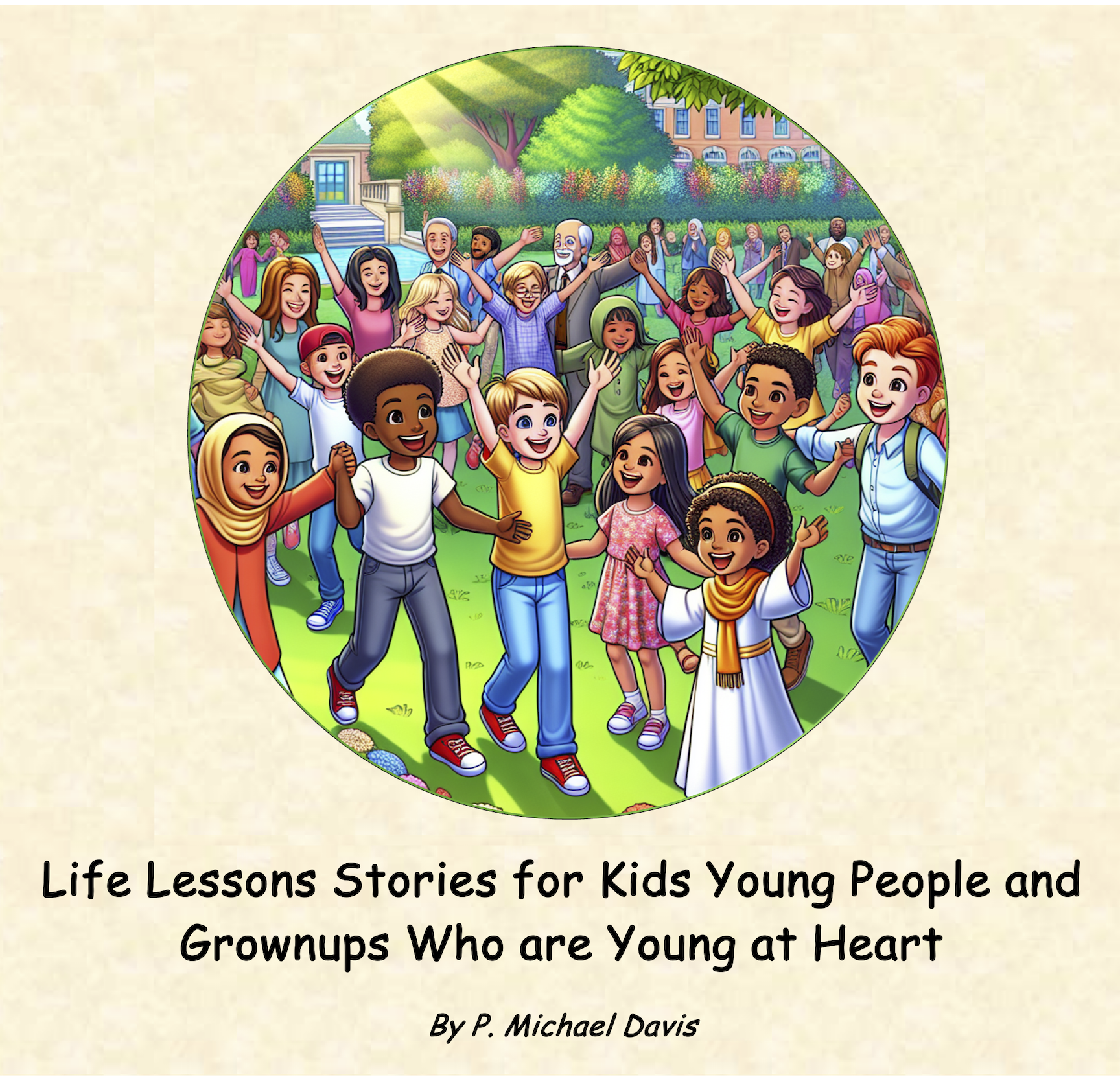
Life Lessons Stories for Kids Young People and Grownups Who are Young at Heart
By P. Michael Davis
This original collection of enjoyable, entertaining, and inspirational stories communicates positive values and principles for happy and healthy living without being preachy, teachy, or boring. By bringing an assortment of unique, interesting, and appealing characters to life in these delightful tales, P. Michael Davis opens the gate into a world where things like kindness, compassion, hope, and perseverance live and thrive. He also clearly communicates important truths about how kids, young people, and grownups can build positive relationships and live in a meaningful and fulfilling way.
Please click the image above for more info and to buy this book.