Our Relationship With God Begins With Love

As we begin this discussion, let me ask you to think about something a little unusual.
Imagine, just for a moment, that you somehow found Aladdin’s magic lamp. You rub it, and out pops the genie, ready to grant you three wishes. Now, setting aside the obvious temptation to wish for more wishes, what would you ask for?
Would you wish for your life to finally fall into place? Would you wish for wealth or financial security? Maybe you would wish to find Mr. or Ms. Right—the person who would make your life complete. Perhaps you would wish for a job or career that would bring you real happiness. Maybe you would wish for your children to be a little more cooperative and a lot better behaved!
Or perhaps your wishes would be less about yourself. You might wish for good things to happen to the people you love. You might even wish that some of the people who have hurt you—or simply some of the jerks you encounter in life—would finally get what they deserve.
But don't answer too quickly.
Take a minute and really think about it. If you were actually given the opportunity to have three things you wanted most in this life, what would they be?
And as you think about your answers, there is another question worth considering: What do those wishes tell you about what you really want out of life?
Okay, so let's come back to reality. There is no Aladdin's lamp sitting somewhere in our lives, no genie waiting to pop out and grant us three wishes. We're not going to get the chance to magically have everything we want.
So that leaves us with an interesting question. If we were honest about the things we wished for, why don't we already have them?
Are some of the things we want simply unattainable? Are they unrealistic or even a little frivolous? Maybe we haven't worked hard enough for them. Maybe we haven't made the sacrifices necessary to get them. Or maybe, in some cases, we simply don't deserve them.
But then again, I look around at the people I know, and that explanation doesn't always seem to work.
I know people who have worked incredibly hard, who have postponed vacations, relationships, family time, and sometimes even whole parts of their lives because they were determined to get ahead. And yet, when they finally get some of the things they worked so hard for, they don't necessarily seem any happier than the people who simply did enough to get by.
And then there are those times when we see someone who seems to have done very little to deserve the good things they have, and yet they seem to have everything handed to them.
What's up with that?
It can be frustrating. It can be annoying. And if we're being honest, sometimes it can feel downright unfair.
Maybe you've had that thought yourself: "I work hard. I try to do the right things. So why doesn't my life seem to work out the way I think it should?"
That's an important question. And perhaps it points us toward something deeper than simply getting the things we wish for.
But I think this may be where the problem lies. There is a prevailing message in our world that life is really “all about me,” and if I am not getting the things and the rewards out of life I really want, then I must be doing something wrong?
Why aren’t we the people we want to be? I’m not talking about the trivial parts of us like looks or weight, or the neurotic parts that get preoccupied with negative comments from others, or even the self-absorbed disappointment we might feel over not having achieved some level of accomplishment or greatness at this time in life. If life is all about our shining individuality, then why are we so disappointed at the prospect that what we have achieved and experienced so far may be all that there is? Why do many of us have this nagging feeling that there must be more to my life, and why can’t we just find it or make it happen?
What really is the problem?
When I was a child, one of my favorite cartoon characters was Popeye the Sailor Man. For those of you who may be too young to remember him, Popeye was a little different from the superheroes we see in cartoons today. He wasn't flying around saving the world or endowed with some extraordinary superpower. He was just a simple, seafaring, spinach-eating, Olive Oyl-loving, pipe-smoking sailor who also seemed to have a little philosophy of his own.
Popeye had a favorite saying, and he said it often:
“I yam what I yam, and that's all that I yam. I'm Popeye the Sailor Man. Toot, toot!”
It's funny when you hear it coming from a cartoon character, but when you stop and think about it, there is actually a pretty profound idea buried in that lyric.
What Popeye was really saying was something like, “This is who I am, and this is probably all I'm ever going to be.” There isn't much point in getting your hopes up. Don't expect too much. Don't imagine that life is going to suddenly become something different. I am what I am, and that's pretty much the end of the story.
Now, of course, Popeye was just a cartoon character. But isn't that sometimes the way we approach our own lives?
If life is really all about me—my abilities, my circumstances, my limitations, my successes and failures—then perhaps Popeye has a point. I am what I am. This is the life I've been given, and maybe this is as good as it's ever going to get.
And if that's the case, then we might as well learn to live with it. No matter how limiting or disappointing our circumstances may be, we simply accept them as reality. We stop expecting anything more.
But here's where I think Popeye missed something important.
As far as I can remember, Popeye didn't have much to say about God. His faith seemed to begin and end somewhere around a can of spinach. And while spinach certainly helped him defeat his enemies, it didn't seem to do much for the quality of his life, his relationships, or his understanding of who he really was.
And perhaps that's the point.
If all I have to work with is me, then Popeye's philosophy makes a certain amount of sense. I am what I am.
But what happens when I begin to understand that my life isn't just about me?
What happens when I begin to see myself as someone who is connected to something greater than myself—to God, to other people, and to a source of love that isn't limited by my own abilities or circumstances?
Maybe then the statement “I am what I am” doesn't have to be the end of the story.
Maybe it can be the beginning of a much bigger one.
So, if Popeye was clueless, and life isn't really all about us as individuals, then what is it about?
Well, as you might expect, my answer is going to be that it is about God and our relationship with God. After all, I spend a lot of time writing and talking about spiritual life and about the difference that spirituality can make in the way we live. What else would you expect me to say?
But here's where things get interesting.
Most of us can honestly say, “I believe in God.” Some of us may even be able to say, “I have experienced a relationship with God.” But if we're really honest with ourselves, we may not have much of an answer to the next question:
What difference does that relationship actually make in my everyday life?
And that's a pretty important question.
I can believe in the Crab Nebula. I can believe that there are galaxies millions or even billions of light-years away. I don't doubt that those things exist. But, as far as I know, they don't have much direct impact on what I do when I get out of bed in the morning, how I treat the people around me, how I deal with difficult circumstances, or how I understand my own life.
And I think a lot of people approach God in much the same way.
“Yes, I believe in God. I believe God exists. I may even believe that God loves me. But what does any of that have to do with how I live my life today?”
That's where I think we often miss something very important.
If God is simply a reality we believe exists somewhere beyond us, then our belief may not change very much. God becomes a fact we accept rather than a relationship we live.
But if our relationship with God is real, then shouldn't it make some difference?
Shouldn't it affect the way we see ourselves, the way we see other people, the way we respond to difficulty, the things we hope for, and perhaps even what we understand the purpose of our lives to be?
That, I think, is where this whole discussion about spiritual love and our relationship with God begins to get really interesting.
So, let’s put all of this into some kind of tangible perspective.
Let me ask you to think about something for a moment: Where do you allow God to be present and active in your life?
Your first response might be, “Anywhere God wants to be.” And that sounds like the right answer. But if we're really honest with ourselves, I don't think that's true for most of us.
The truth is, we tend to decide which parts of our lives are open to God and which parts we would rather keep to ourselves. We may welcome God into our worship, our prayers, or the difficult moments when we really need help. But what about our relationships? Our money? Our careers? Our ambitions? Our fears? Our choices? What about those parts of our lives where we like to remain firmly in control?
And here's something else worth considering: I don't believe God forces God's way into any of those places. God isn't pushy. God doesn't barge into our lives uninvited or demand a place at the table.
The kind of relationship God wants with us is something much deeper than that. It is a relationship that is personal, meaningful, intimate, and freely chosen.
And that means something important for us. We have to open the door.
We have to be willing to say, “God, I want you to be part of my life—not just the religious part of my life, but my real, everyday life.”
And I'm not sure many of us have ever stopped to think about what that actually means.
What would it mean to live with God as a genuine presence in our everyday lives? What might change in the way we think, the way we make decisions, the way we treat people, and even the way we understand ourselves?
Those are the questions I think we need to explore, because a relationship with God isn't simply something we say we believe in. It is something we can actually learn to live.
What does it mean to have a deep and intimate relationship with God?
A deep and intimate relationship with God means that God isn't just present in the religious parts of our lives. God becomes part of all of it.
Think about that for a moment. God is present in the things we are proud of and the things that make us happy. God is present in the things we are ashamed of—the things we'd just as soon keep hidden. God is even present in those not-so-nice things we sometimes want to get away with because we don't want anyone looking too closely.
God belongs in our money and our jobs, in our friendships and our marriages, in our learning and our decisions, in our sense of humor and the things we laugh about, in our love lives and in the way we raise our children.
In other words, a real relationship with God doesn't allow us to neatly divide our lives into the “God stuff” and everything else.
It puts God right in the middle of the good, the bad, and the ugly.
And that's where this kind of relationship becomes both challenging and incredibly meaningful. If we really invite God into the whole of our lives, then eventually that relationship begins to change the way we see almost everything.
It changes the way we see ourselves. It changes the way we see other people. It changes how we make decisions, how we handle conflict, how we use our time and resources, and how we respond to the ordinary events of everyday life.
In fact, that's probably the best way to understand what a genuine relationship with God can do. It doesn't simply add something spiritual to the life we're already living. It can change the way we live our whole life.
Now, let me be clear about something. For those of us who are looking for meaning and purpose, for a deeper sense of fulfillment and peace, and for a genuine experience of unconditional love and acceptance, this kind of relationship with God can be incredibly life-giving.
But there is another side to it.
If I am determined to keep everything centered on myself, to remain in complete control, and to have life work according to my plans and expectations, then this kind of relationship is going to be difficult.
Why? Because a genuine relationship with God asks us to open ourselves to something beyond ourselves. It asks us to loosen our grip on the idea that we have to control everything. It asks us to trust, to listen, to be willing to change, and sometimes to let go of what we thought we needed.
And that can be hard.
Most of us like to be in control—at least of the things we think we can control. We like making our own decisions, setting our own priorities, and determining how our lives should unfold.
But if we really invite God into the middle of our lives, then eventually we have to ask ourselves a challenging question:
Am I willing to let this relationship change me?
Because that's where the real adventure begins. A relationship with God isn't simply about adding another belief to the list of things we believe. It is about becoming open to a way of living that can gradually change what we value, how we see ourselves and others, and what we understand a meaningful life to be.
So, let's get a little more concrete. What actually changes when we develop this deep and intimate relationship with God?
I think the short answer is pretty simple: we change.
But what does that really mean?
Think for a moment about one of the best and longest friendships you've ever had. What is it about that relationship that has given it meaning and allowed it to last?
If I were making a list, I suspect some of these things would be on it.
First, there is trust. You know this person is someone you can count on. Maybe they can't fix whatever problem you're facing, and they may not even have an answer for you, but you know they will be there. Sometimes, just knowing that someone is there makes all the difference.
Then there is someone you can talk to. When you're confused, when you don't know what to do, or when you simply need someone to listen without judging you or immediately trying to solve your problem, this is the person you call.
And then there is acceptance. This friend knows you—the good, the bad, and everything in between—and accepts you for who you are. They don't constantly feel the need to judge you, straighten you out, or turn you into someone you're not.
And finally, there is something else that often happens in our deepest friendships. We grow.
If you've had a really good friend for many years, chances are that person has been there through some difficult times. Maybe they encouraged you when you were struggling. Maybe they challenged you when you needed to be challenged. Maybe they simply walked alongside you while you figured things out for yourself.
And somewhere along the way, you changed.
You became a little wiser, a little stronger, a little more compassionate, or perhaps simply a little more comfortable with who you are.
You probably didn't enter the friendship thinking, “This person is going to help me become a better version of myself.” That wasn't the point. You were simply friends. But because of the relationship, growth happened.
And I think that's something we sometimes overlook about deep and intimate relationships.
We discover ourselves as we come to know another person.
The relationship doesn't just teach us about our friend. It teaches us something about ourselves.
And perhaps that's one of the most important things that can happen in a deep relationship with God. As we become more open to God, we may discover that we are not simply learning more about God.
We are learning more about ourselves—and who we might become.
Those are the kinds of things that can happen when we invite God into a genuine relationship with us.
God becomes that trusted and loving presence we can turn to when we don't know what to do. A presence that listens without judgment and without immediately trying to fix the problem—or fix us. A presence that accepts us and loves us as we are, while at the same time encouraging us to grow, learn, and become more fully the people we were created to be.
But I think there is something even more important that can happen.
Our relationship with God can help us find ourselves.
Not the person we pretend to be. Not the person we think other people expect us to be. And not simply the person we've become because of our circumstances or our mistakes.
Rather, God can help us discover the real person within us—the person we sometimes glimpse but don't quite know how to become. The person we deeply want and aspire to be.
And that, to me, is where this kind of relationship becomes truly life-giving.
A deep relationship with God doesn't take away who we are. In a very real sense, it helps us become more fully who we are.
If that's what we're looking for, then allowing God into the center of our lives can change almost everything for the better.
And if we're not ready for that kind of relationship, that's okay, too. God isn't standing at the door demanding that we let God in or insisting that we have some particular kind of relationship.
God can meet us wherever we are and work with whatever we're willing to offer.
Perhaps we begin with a little openness. Then a little more trust. Then a little more honesty.
And, sooner or later, we may discover that we are ready to open ourselves to something deeper—something more intimate, more meaningful, and ultimately more life-giving than we ever imagined.
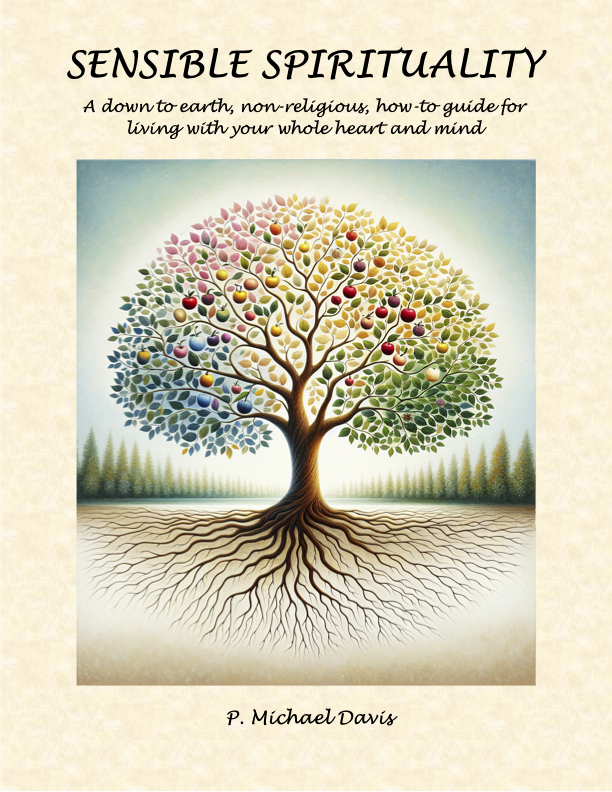
Sensible Spirituality
A down to earth, non-religious, how-to-guide for living with your whole heart and mind
While there are a multitude of books about personal development and spiritual growth, author and storyteller P. Michael Davis goes down a different path by offering a real-life conversation about how to build and maintain a positive and spiritually healthy life.
His approach is thoroughly non-religious, entertaining, and devoid of jaw clenching seriousness. He will walk you through the whys and how tos of spiritual awareness, spiritual relationship building, spiritual love, and spiritual parenting for children and adolescents.
Sensible Spirituality is available, by clicking the book cover above, in kindle, paperback, and audio book formats at Amazon.com.

Life Lessons Stories for Kids Young People and Grownups Who are Young at Heart
By P. Michael Davis
This original collection of enjoyable, entertaining, and inspirational stories communicates positive values and principles for happy and healthy living without being preachy, teachy, or boring. By bringing an assortment of unique, interesting, and appealing characters to life in these delightful tales, P. Michael Davis opens the gate into a world where things like kindness, compassion, hope, and perseverance live and thrive. He also clearly communicates important truths about how kids, young people, and grownups can build positive relationships and live in a meaningful and fulfilling way.
Please click the image above for more info and to buy this book.