RELIGION AND SPIRITUAL DEVELOPMENT

Before we go much further, I should probably tell you where I'm coming from.
Although my approach to spiritual growth isn't tied to any particular religion, the language and framework that feel most natural to me come from the Judeo-Christian tradition. It's the tradition I know best, the one that has shaped my life, and the one through which I have experienced God most deeply.
That doesn't mean I see it as the only path to God—or even the best path for everyone. I don't believe God can be confined to any one religion, denomination, or set of beliefs. I'm not interested in convincing anyone to adopt my faith tradition, nor do I think spiritual growth depends on belonging to a particular religion.
You might find that a little surprising coming from someone who spent much of his life serving as a Christian clergyperson.
So how did I arrive at that perspective?
Ironically, it wasn't because I had a bad experience with Christianity. It was because I had a very good experience outside of it.
Although I was raised in the Catholic Church, during the early 1970s—long before I ever imagined becoming a minister—I became deeply interested in Zen Buddhism. I had grown somewhat disillusioned with Christianity as I understood it at the time, and Zen opened a door to a different way of seeing the world.
For three years I studied seriously, trained with a Zen teacher, and practiced meditation faithfully. Then one day my teacher gave me some of the wisest spiritual advice I've ever received.
He smiled and said, "You're hopelessly Christian."
At first, I wasn't quite sure what to make of that.
But he wasn't criticizing me, and he certainly wasn't saying I had failed at being a Zen student. What he was doing was helping me recognize my own spiritual home.
He explained that I could no more fully become a Buddhist than he could worship a tortured man hanging on a cross. Our spiritual paths were different, he said, but one wasn't better than the other. They were simply different ways of walking toward the same mystery.
To this day, I consider him one of the holiest and most spiritually aware people I have ever known. His humility, wisdom, and openness taught me as much about God as any sermon I have ever heard.
Perhaps the greatest gift he gave me was encouraging me to return to my own tradition—not because it was superior, but because it was where my heart belonged. Looking back, I believe he was exactly right.
That doesn't mean his path should be yours, or mine should be yours.
I won't suggest that any particular religion is necessary for spiritual growth. For some people, a religious tradition provides a rich and meaningful framework for discovering God. For others, the journey may unfold in different ways.
My hope isn't to persuade you to follow my path.
It's simply to invite you to explore your own with honesty, openness, and curiosity. If something from my journey helps illuminate yours, then I'll be grateful. And if your path looks different from mine, I believe that's perfectly all right.
After all, the destination matters far more than whether we all travel the very same road.
SEEING SPIRITUALITY IN A DIFFERENT WAY

If you've spent any time reading about spirituality, you've probably noticed that much of what's written focuses on the mystical, the supernatural, the metaphysical, the transcendent, or other ideas that seem to belong to a world beyond our everyday experience.
There's certainly nothing wrong with exploring those subjects. Many people find them fascinating and deeply meaningful.
But over the years, I've come to see spirituality a little differently.
In my experience, the real test of a spiritual life isn't found in extraordinary experiences or mysterious insights. It's found in the ordinary moments of everyday living. It's reflected in how we treat other people, how we respond to disappointment, how we forgive, how we love, how we find purpose, and how we navigate the challenges that every one of us eventually faces.
For me, spirituality has always been far more about learning how to live well than about trying to escape into something "otherworldly."
That's the kind of spirituality we'll be exploring here—a spirituality with its feet firmly planted on the ground while its heart remains open to the mystery of God.
One of the biggest misconceptions about spiritual growth is that it's something we go out and find—as if it's hidden somewhere, just waiting for us to discover it. Others think it's something we can acquire through enough knowledge, the right religious beliefs, or a particular set of spiritual practices.
Those things can certainly be helpful. They can deepen our understanding and enrich our journey.
But I don't believe they are spirituality itself.
To me, spirituality isn't something we possess. It's a way of living.
It's choosing to move through life with an open heart, an open mind, and a growing awareness that there is something greater than ourselves at work in the world. It's a willingness to enter into a relationship with God—or with the Divine, however you understand and experience that reality.
Spiritual growth isn't about reaching a destination where we finally have all the answers. It's about becoming more aware, more compassionate, more loving, and more fully alive as we continue walking the path.
In the end, spirituality isn't simply something we believe. It's something we live, one ordinary day at a time.
SPIRITUAL AWARENESS
HOW DOES IT AFFECT OUR EVERYDAY LIVES?
When I was in seminary, one of my professors gave us an assignment that sounded simple enough: write a paper explaining the difference between living with spiritual awareness and living without it.
The more I thought about it, the more I realized I couldn't explain it very well with words.
So I didn't write a paper.
Instead, I built a board game.
It started out looking like any other board game—about the size of a Monopoly board—with a spinner and little game pieces that players moved around the board. The spaces represented the ordinary events of life: birth, school, work, romance, marriage, children, career, success, disappointment, and all the other experiences that fill our days.
But there was a twist.
Scattered around the board were three spaces labeled Spiritual Awareness.
If a player landed on one of those spaces, something unexpected happened. The small game board unfolded into one nearly one hundred times its original size. I had actually built it using ten king-size bedsheets sheets taped together. Suddenly the player wasn't confined to the small board anymore. They moved onto this enormous landscape filled with countless new paths, opportunities, and possibilities.
That was the entire point of the game.
To me, spiritual awareness doesn't take us out of everyday life. It opens us more fully to it.
The events of life don't suddenly change. We still experience work and family, joy and sorrow, success and failure. But we begin to see them differently. We recognize possibilities that were always there but that we simply couldn't see before.
That's what spiritual awareness has come to mean to me.
It's the doorway that opens us to a much larger reality. It's the lens that allows us to see beyond the obvious. It's the awakening that reminds us life is infinitely richer, deeper, and more meaningful than it first appears.
Whether we think of it as a gate, a doorway, a window, or simply an awakening of the heart, spiritual awareness expands our vision. It helps us recognize that we are living in a world overflowing with opportunities for love, growth, compassion, purpose, and joy—opportunities we might otherwise walk right past without ever noticing.
That's why I believe spiritual awareness isn't just one part of the spiritual life.
It's the doorway through which the whole journey begins.
Where the Rubber Hits the Road
As our spiritual awareness grows, something remarkable begins to happen.
The world around us doesn't necessarily change—but the way we experience it does.
We begin to see that spirituality isn't separate from everyday life. It isn't reserved for Sunday mornings, quiet retreats, or moments of meditation. Instead, it becomes woven into everything we do. It shapes the way we approach our work, our marriages, our families, our friendships, and our relationships with our children. It influences how we respond to success, disappointment, conflict, and change.
Little by little, we begin to discover not only more about God, but more about ourselves.
We gain a clearer sense of who we are, why we're here, and what truly gives our lives meaning and purpose. We begin to experience a deeper sense of fulfillment—not because life suddenly becomes easy, but because we start living from a place of greater peace, gratitude, and hope.
That's one of the greatest gifts of a growing relationship with God.
The more we become aware of God's presence, the more we begin to recognize that life is filled with possibilities we may never have imagined. Doors that once seemed closed no longer appear permanently locked. Problems become challenges to work through instead of walls that stop us. Even our failures can become teachers rather than final verdicts.
Hope begins to replace discouragement.
Courage begins to replace fear.
And instead of asking, "Why is this happening to me?" we begin asking, "What is this experience inviting me to learn? Where is God at work in this moment?"
Those questions don't remove life's struggles. But they do change the way we walk through them.
That's the practical power of spirituality.
It doesn't take us out of the real world. It helps us live more fully, more wisely, and more joyfully within it.
Can people live without spiritual awareness?
Of course, not everyone sees life this way.
Many people live quite comfortably without giving much thought to spiritual awareness. Some dismiss it as naïve, sentimental, or unrealistic. Others see it as wishful thinking—something for people who can't face the "real world." Still others argue that if a relationship with God can't be measured, tested, or proven by science, then it simply can't be real.
I understand those perspectives.
But I've never found them very satisfying.
It seems to me they begin with the assumption that only what can be measured is real. Yet some of the most important things in life refuse to fit inside a laboratory or a mathematical formula.
How do you measure hope?
How do you prove love?
What instrument can detect beauty, trust, compassion, or genuine friendship?
We may not be able to measure those things with scientific precision, but few of us would argue that they don't exist. In fact, they're often the very things that give life its deepest meaning.
I think spiritual awareness belongs in much the same category.
It's less about proving God than it is about experiencing God's presence. It's less about winning an argument than it is about living a fuller, richer, and more meaningful life.
Can a person live without that awareness?
Certainly.
People do it every day.
But from my perspective, it's a bit like living in a house with all the curtains closed. You can still find your way around. You can still function. But you'll never see the beauty that's waiting just outside the window.
Spiritual awareness opens those curtains.
It invites us into a larger, richer experience of life—one filled with greater hope, deeper relationships, unexpected possibilities, and a growing sense that we are part of something much bigger than ourselves.
Once you've caught even a glimpse of that larger reality, it's hard to imagine wanting to live any other way.
How does someone go about becoming spiritually aware?

So where do we begin?
The first thing to remember is that spiritual growth is a process, not an event. There isn't a finish line to cross or a point where we can finally say, "I've arrived." We spend our entire lives growing, learning, stumbling, and beginning again.
That's actually good news.
It means there isn't one "right" way to grow spiritually. Each person's journey is unique. We all come from different backgrounds, ask different questions, and encounter God in different ways. Even so, there are some reliable signposts along the way—things that help us recognize when we're moving toward a richer, healthier spiritual life and when we've wandered off the path.
The second thing I would encourage you to remember may be the most important of all.
Don't give up.
There will be times when other people don't understand the changes you're experiencing. There will be moments when the journey feels confusing or painfully slow. Some days you may wonder whether you're making any progress at all.
Keep going.
Spiritual growth rarely happens in dramatic leaps. More often, it unfolds quietly, almost unnoticed, as we continue choosing love over fear, hope over despair, forgiveness over resentment, and trust over certainty. Looking back, we often discover we've grown far more than we realized while we were living through it.
Then, somewhere along the way, something begins to shift.
We start to recognize that life is much bigger, richer, and more meaningful than we once imagined. We begin to sense that God is present in ways we had never noticed before. That awareness doesn't answer every question, but it changes the questions we ask.
From that point on, the journey becomes less about searching for God and more about learning to live in the reality of God's presence.
And that's really what spiritual growth is all about.
It's the lifelong adventure of allowing that growing awareness to shape the way we think, the way we love, the way we serve, and the way we live every ordinary day. Little by little, it enriches our relationships, expands our understanding, and helps us become the people we were created to be.
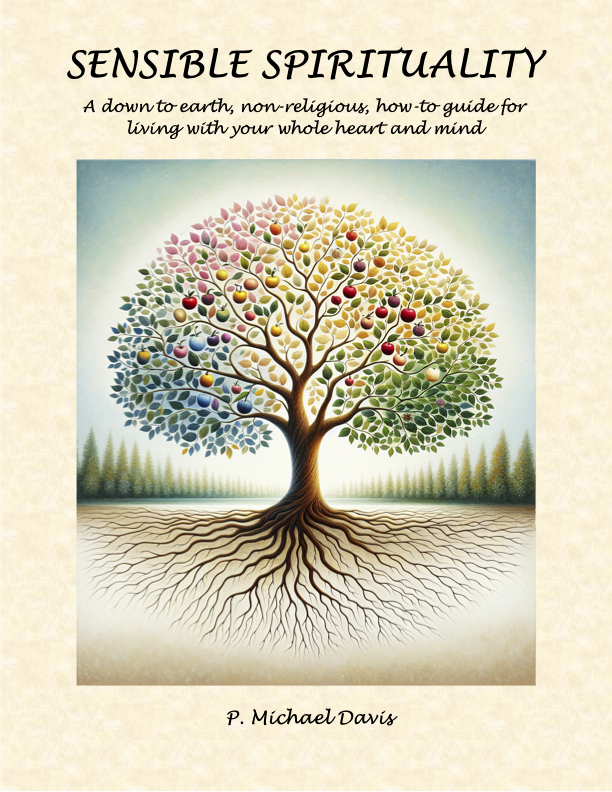
Sensible Spirituality
A down to earth, non-religious, how-to-guide for living with your whole heart and mind
While there are a multitude of books about personal development and spiritual growth, author and storyteller P. Michael Davis goes down a different path by offering a real-life conversation about how to build and maintain a positive and spiritually healthy life.
His approach is thoroughly non-religious, entertaining, and devoid of jaw clenching seriousness. He will walk you through the whys and how tos of spiritual awareness, spiritual relationship building, spiritual love, and spiritual parenting for children and adolescents.
Sensible Spirituality is available, by clicking the book cover above, in kindle, paperback, and audio book formats at Amazon.com.

Life Lessons Stories for Kids Young People and Grownups Who are Young at Heart
By P. Michael Davis
This original collection of enjoyable, entertaining, and inspirational stories communicates positive values and principles for happy and healthy living without being preachy, teachy, or boring. By bringing an assortment of unique, interesting, and appealing characters to life in these delightful tales, P. Michael Davis opens the gate into a world where things like kindness, compassion, hope, and perseverance live and thrive. He also clearly communicates important truths about how kids, young people, and grownups can build positive relationships and live in a meaningful and fulfilling way.
Please click the image above for more info and to buy this book.